
Last time I wrote about the rising prices of refined products and their outsized influence on inflation. More on that here: Inflation is not a WTI or Brent story. Since then, oil has reclaimed a large chunk of its earlier drop, while refined product prices have reached multiyear highs. There are also significant differences in diesel prices at the pump between states, part of the reason why a unanimous decision to restrict export’s seems unlikely.
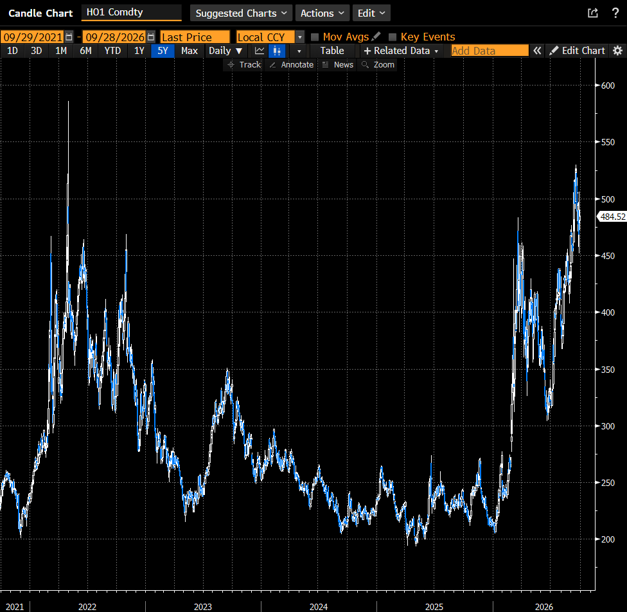
The American Automobile Association (AAA) reported a record US average diesel price of $6.53 per gallon on September 22. That might not sound like much to a European, it is roughly €1.50 per liter, but for Americans who, until recently, were enjoying fuel below €1 per liter, it is a large change. The price has eased slightly since the record, but that hardly amounts to relief.
NY Harbor Ultra-Low Sulfur Diesel
Source: Bloomberg, InterCapital
A little over two months later, the US administration has picked up on the problem as well. Senators and representatives from several food-producing states, most hit by the price increases, have pushed for a diesel export ban. Trump himself has backed the proposal, with Bessent tasked with examining whether a full or partial ban would be feasible. Many in the industry argue that it would make things worse. But Trump is known to act on his own views and beliefs, often surrounding himself with voices that reinforce them. As we have repeatedly seen on interest rates, his reasoning rarely seems to reach far. So, the risk that he imposes a ban against the advice of his own energy officials still exists. Emergency powers under IEEPA might offer a route to act without a new vote in Congress, although whether they could lawfully be used for this particular ban is less clear.
The White House later denied a report that it was preparing a 90-day ban. I see this as another example of the headline politics and market influence the administration has employed since day one. Problems with which the president’s decisions have contributed are met with threats of another impactful decision, followed by a retreat if the market reaction is not the one he wanted. Trump and Bessent’s tool of choice is strong wording designed to provoke a market response, in the hope that they will never have to follow through. That possibility is hard to ignore here: Trump and Bessent are discussing a ban publicly, while Energy Secretary Wright has repeatedly opposed one and explained how it could reduce refinery runs and, with them, the supply of other fuels.
Merely floating an export ban could also encourage the opposite behavior from the one intended. Until a ban is enforced, exporters have an incentive to ship as much diesel as they can to markets such as Europe, while buyers have an incentive to secure US cargoes before they lose access to them. We have seen a similar rush to move metal ahead of a possible policy change in the LME–COMEX copper trade over the past year. Of course, vessels, terminals and contract terms limit how much can actually be brought forward. But this is not as straightforward as hinting at an intervention in the yen, where the threat of a sudden move can cause participants to slow down. Here, the threat could make them hurry up.
I do not want to guess whether Trump will actually impose the ban. That would mean predicting which adviser gets the last word and whether the White House will still like its own idea after the market reacts. I would rather ask what happens to diesel and gasoline under either outcome.
Russia offers a useful warning, though not quite the simple one politicians might expect. Its 2023 export ban coincided with a sharp fall in domestic wholesale diesel prices, but much less of that decline reached the pump, and most restrictions were eased after two weeks as storage pressure built. Russia tried again this July, this time against a backdrop of damaged refineries and domestic shortages. Diesel prices inside Russia stopped rising, while US diesel futures jumped on the announcement. An export ban can change where diesel is cheap. It cannot repair a refinery or create the barrels missing from the global market.
The same logic applies here. The lasting ways to lower diesel prices are to restore disrupted supply or produce more diesel. Neither looks achievable on an election timetable. A ban might temporarily make diesel cheaper near the refineries that would otherwise export it, but it cannot instantly deliver that fuel to every US state that needs it. That is why the differences between states matter: a lower wholesale price somewhere in the country is not automatically a lower pump price everywhere.
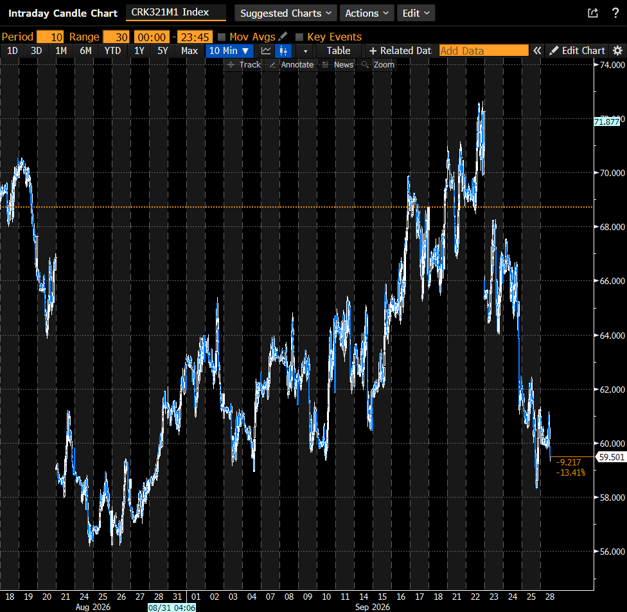
US cracks have fallen since the first serious ban comments.
3-2-1 Crack Spread
Source: Bloomberg, InterCapital
If the administration backs away and the physical shortage remains, a long diesel crack (HO against CL) could benefit as the policy discount fades. It expresses the diesel view more directly than a 3:2:1 crack, where gasoline accounts for two of the three product barrels. But buying the dip is still a view that the ban will not cause lasting damage to diesel prices.
If a broad ban does arrive, the first reaction could be further weakness in HO and the HO–CL crack. What happens afterward depends on how long refiners can store the diesel they would otherwise export. If they eventually cut runs, they will produce less gasoline and jet fuel too. This narrative going mainstream is something to wait for with a finger on the trigger. That could support the RB–CL gasoline crack even as diesel weakens.
I would therefore watch the HO–CL and RB–CL cracks, HO calendar spreads, export loadings, inventories and refinery runs. Falling HO cracks alongside continued exports and tight stocks would look very different from falling cracks accompanied by a genuine build in diesel inventories. I would rather trade that difference than bet on the next press release.