
Recently, NLB Group held its 2026 Investor Day in Sarajevo, during which it also presented an updated Strategy 2030. During the many presentations, they have given a detailed breakdown of where they expect the Group will go, including an overview of the Group’s main segments. In this blog, we dive deep into their strategy, as well as ask ourselves the question: are the goals set within the strategy possible?
NLB first presented its “Strategy 2030” during the last investor day in 2024, in which they set ambitious targets, including EUR 50bn of assets, EUR 2bn of recurring income, and a net income of EUR 1bn by 2030.
Since then, around 2 years have passed, and the Group has, during its recent 2026 Investor Day, presented its updated strategy. It should be noted that the updated strategy separates the organic path from M&A upside. As M&As are by their very nature uncertain, this overview focuses on the organic plan.
Overview of NLB Group’s “Strategy 2030” key KPIs (2026 updated strategy vs. 2024 ID actuals vs. 2025 YE actuals, EURm)
| wdt_ID | Indicator | 2024 ID | YE 2025 | 2030 Target |
|---|---|---|---|---|
| 2 | Total assets | EUR 26bn | EUR 31.5bn | Organic EUR 45bn, with M&A: EUR 50+bn |
| 3 | Recurring revenues | EUR 1.1bn | EUR 1.3bn | Organic >EUR 1.8bn, with M&As >EUR 2bn |
| 4 | Net income | EUR 0.5bn | EUR 0.5bn | Organic >EUR 0.85bn, >EUR 1bn with M&As |
| 5 | CIR | 46% | 47.4% | 45%, with aim of low 40% |
| 6 | ROTE | 22% | 15.2% | >15% |
| 7 | Normalized ROE | 29% | 20.50% | >20% |
| 8 | Payout ratio | approx. 40% | 50% | 50-60%, moving towards 60% |
| 9 | P/B | 0.8x | 1.1x | approx. 1.5x |
| 10 | Tier 1 capital ratio | 16.90% | 17.40% | approx. 15% |
| 11 | CET1 ratio | 16.40% | 15.40% | >13% |
Source: NLB Group, InterCapital Research
By KPIs, NLB’s total assets stood at EUR 26bn during 2024 Investor Day (ID), based on 2023 actuals, increasing by 21% to EUR 31.5bn by the YE 2025. The Group’s aim is EUR 45bn for the organic target, with EUR 50bn+ seen as achievable only in the case of M&As. Recurring income stood at EUR 1.1bn in the 2024 ID, increasing to EUR 1.3bn by the end of 2025, and expected to be above EUR 1.8bn by 2030, and >EUR 2bn if M&As are also included. Net income, meanwhile, did not record a meaningful change, standing at around EUR 0.5bn during both the 2024 ID and 2026 ID, due to the change in the rate environment and the related margin pressure, together with funding costs and non-recurring effects, rather than a lack of underlying business growth. In other words, all else being equal, if the rates remained closer to the 2024 ID levels, net income would likely have been meaningfully higher. The aim for this line is EUR 0.85bn organically, and >EUR 1bn in case of M&As.
Other important items include a cost-to-income ratio (CIR) of 46% during 2024 ID, 47.4% during 2026 ID, but compared to the initial strategy that aimed at <45% for this ratio, NLB expects faster revenue and slower OPEX growth, leading to this ratio being “upgraded” to the low 40% range in the newly presented strategy.
Payout ratio has also been upgraded, standing at around 40% during 2024 ID, 50% as of YE 2025, and expected to move towards 60% by 2030. NLB’s ambitions, including the potential net income growth, but also a “repricing” of its P/E towards 8-9x, also support the P/B target of approx. 1.5x by 2030 (2024 ID: 0.8x, 2026 ID: 1.1x).
In other words, NLB’s updated strategy hasn’t changed much compared to what they targeted during the 2024 ID, although the focus now is more on organic growth and execution, which could lead to those numbers. Moving forward, the Group expects loan CAGR of 9% in the 2025 – 2030 period, with increases in both retail and corporates, but especially in household growth. Deposits are expected to grow at an 8% CAGR during the same period, and NLB noted that this is self-funded growth, as they remain dedicated to the region. This self-funded growth model reduces reliance on volatile wholesale funding and limits the type of liquidity risk that became visible in several US and European bank stress events in recent years.
Despite the interest rates now being at lower levels than in the 2024 ID, NLB has effectively reduced net interest income (NII) sensitivity by increasing the % of fixed loans, increasing the share of bonds, and through solid hedging strategies. As such, even though the rates are lower, they still expect that the net interest income will grow, from EUR 0.95bn in 2025, to approx. EUR 1.4bn by 2030, implying an 8% CAGR. The Group net interest margin (NIM) is expected to stand above 3% throughout the strategic period, at levels seen in 2025, but this assumes a stable ECB rate outlook and SEE margin stabilization.
Costs are expected to grow at 4-5% per annum, below the expected 8% revenue growth, implying that revenue should grow about 2x the cost growth. This growth should remain controlled, despite IT investments, which are expected to run at around EUR 160-200m per annum, and NLB was pretty clear that this would be self-funded through staff and branch savings, maintaining the cost discipline. Within the costs, they also expect a 15% headcount decrease compared to the 2025 base, as the digitalization efforts, closing of branches, and focus on IT employees continue.
There are many other indicators that NLB mentioned, including RWAs, CET1, and Tier 1 equity targets, and for more details on those, click here. For now, we focus on each segment before answering whether this is plausible.
Retail segment
The largest and most important segment for most banks, including NLB, is retail.
Retail historical revenue & expectations based on “Strategy 2030” (FY 2023 vs. FY 2025 vs. 2030 target, EURm)
Source: NLB Group, InterCapital Research
NLB’s retail revenue grew at an 11% CAGR in the 2023 – 2025 period, reaching EUR 873m during FY 2025, and NLB is planning to grow this revenue at a CAGR of approx. 8% in the 2025 – 2030 period, reaching >EUR 1.3bn by then. This is based on both an increase in the number of clients as well as an increase in revenue per active client. Retail clients stood at >2.7m during 2024 ID, with revenue per active client of EUR 270. By 2025, NLB reached 2.8m active clients, with revenue of EUR 300/active client. The 2030 target stands at >3m clients, with revenue/active client at >EUR 400. However, rather than brute-forcing their way to this, they aim to improve the customer experience and offer them a wider range of services, which would both attract new clients & increase the revenue per active client.
NLB also aims to become the “digital-first” bank, aiming to increase the active clients’ digital penetration, which stood at 39-60% during 2024 ID, increasing to approx. 62% during YE 2025, with the aim of >80% as of the 2030 target. They also aim to increase digital core product sales, which stood at a low 2-6% during 2024 ID, increasing to approx. 16% during YE 2025, with the aim of >50% by 2030. Lastly, digital acquisition of clients remained very low, at 0.4% in 2025, versus a 2030 target of >30%.
Within this segment, they also aim to increase the fee income, which stood at approx. EUR 230m as of YE 2025, to approx. EUR 330m by 2030, implying a 7-8% CAGR. They aim to increase this through a diversified structure of products, including daily banking, bancassurance, asset management, and lending. The aim with this is to further reduce the NII dependency, as this income line is more stable and not dependent on rate cut/hike cycles. The increased digital penetration also supports this income line.
The full detailed breakdown of the retail segment can be accessed here.
Corporate & Investment Banking segment
In the corporate and investment banking segment, NLB recorded revenues of EUR 300m in 2023, increasing to EUR 324m as of the end of 2025, implying a 4% CAGR, driven by 8% NII increase from loans, while deposits contributed a negative 2% to this increase. By 2030, NLB aims to achieve approx. EUR 500m in revenue in this segment.
CIB historical revenue & expectations based on “Strategy 2030” (FY 2023. vs. FY 2025 vs. 2030 target, EURm)
Source: NLB Group, InterCapital Research
Back in 2023, the revenue per active client amounted to EUR 12.5k, increasing to EUR 15.4k as of the end of 2025, with a target of EUR 20k by 2030. NLB is also aiming to reduce NII dependence here, as net non-interest income (NNII) amounted to 27% in 2023, 28% in 2025, with the target of >37% by 2030, similar to what they’re doing in the retail segment. The cross-sell ratio, which measures how many products are used by clients, amounted to 3.2 in Slovenia in 2023, increasing to 3.9 in the country in 2025, while other countries where NLB operates had a ratio of between 2.3 and 4.9. By 2030, they aim to increase this ratio to 4.0 across the Group.
To achieve this, NLB is aiming for sustained revenue expansion, combined with disciplined cost and risk management across all CIB segments. Like with retail, they aim to significantly increase digitalization, allowing clients everything from onboarding, lending, to trade execution. They’re also bringing innovation here, scaling the trade finance business and fee-based revenue through (yet unnamed) capital-efficient product solutions across the SEE.
To achieve this, within this segment, they estimate a 2025 – 2030 CAGR of 14% for investment banking & other, 8% for cards, 9% for trade finance, 5% for payments, and 8% for NII (including both loans & deposits). NLB is also positioning itself as the regional transition finance leader. Total CIB stock loan volume amounted to EUR 6bn in 2023, EUR 8bn in 2025, and is targeted at >EUR 12bn in 2030. Within this, green financing stock increased from EUR 0.3bn to EUR 1bn, with a 2030 target above EUR 1.3bn.
NLB went into quite a detail as to how they plan on achieving all of this within this segment, and if you’re interested in more, click here.
Payments
While a part of other segments (such as retail or CIB), NLB did highlight payments as one of the key drivers for their growth up until 2030. Revenues stemming from this amounted to EUR 207m in 2023, growing at a 7% CAGR to EUR 236.5m in 2025, and are planned to grow at a CAGR of 6% from 2025 to 2030, reaching >EUR 320m by then.
Payments historical revenue & expectations based on “Strategy 2030” (FY 2023 vs. FY 2025 vs. 2030 target, EURm)
Source: NLB Group, InterCapital Research
Within this, NLB has several aims, and one of the most important ones is the higher wallet penetration (NLB Pay Mobile wallet), which had a share of 10-15% in 2023, growing to 25.9% in 2025, with a target of >40% by 2030. For NLB, the strategic benefit is twofold: fewer cash transactions reduce branch and handling costs, while more card and digital transactions increase fee income, customer data, and relationship stickiness.
According to the Group, cash transactions in branches related to retail amounted to 32% in 2023, declining to 15.1% in 2025, and the 2030 target stands at <10% in 2030. However, outside the branches, cash is king. In the SEE region, 60-80% of transactions are done in cash, something that NLB sees as a “massive displacement opportunity” as digital usage increases.
Furthermore, NLB sees SEPA adoption as a key catalyst for faster and cheaper cross-border euro payments in the region. Separately, card payments in the region have already been growing strongly, with 2019-2025 CAGRs of around 11-27% depending on the market. In other words, the aim here is to increase card & digital transactions, whilst at the same time, offering a broader range of services and products as compared to traditional lending.
One other segment where NLB sees growth opportunities is merchants. Within the SEE region, a transaction pool of >EUR 120bn exists, with approx. 64% to 80% of payments at POS (point of sale) are done in cash. With the aim of increasing its share with the merchants in the region, they aim to increase the card/digital transaction numbers, thus being able to achieve higher revenues from fees.
The full, detailed breakdown of Payments can be accessed here.
Leasing segment
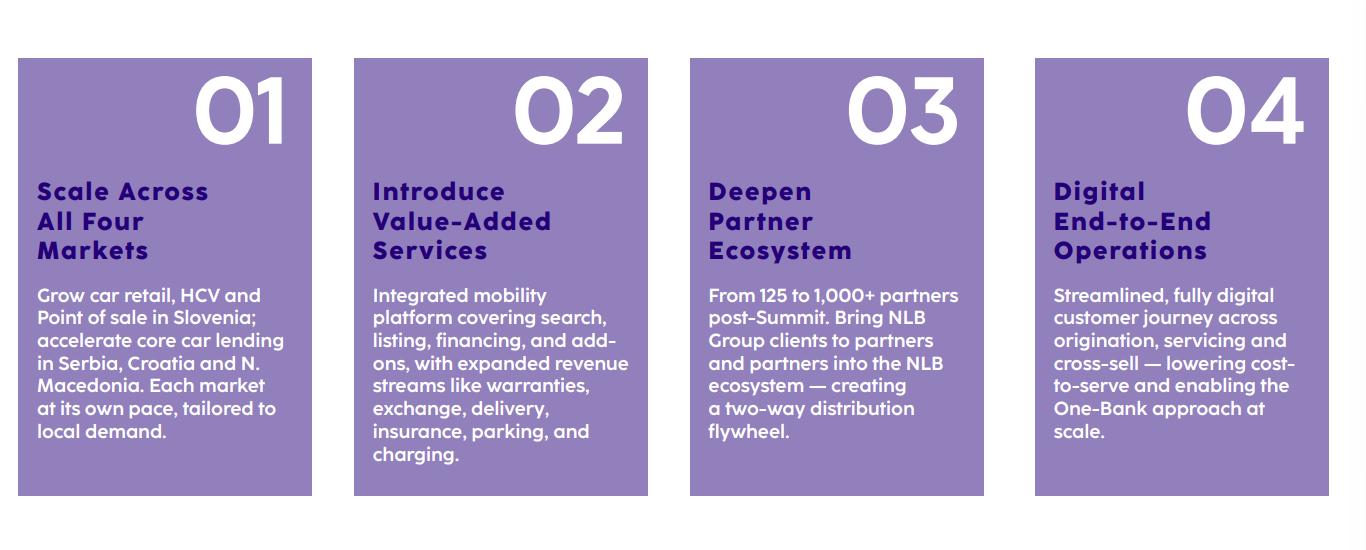
NLB also commented on the leasing segment, something that has been growing steadily within the Group for the last couple of years, both organically and inorganically. While the leasing segment was founded in 2020, its growth accelerated from 2022 to 2025 through a combination of organic expansion and M&As, especially the Summit/SLS transactions, which strengthened Slovenia and added Croatia.
Currently, NLB has regional footprint in those 4 markets, with a 35% market share in Slovenia (EUR 1.37bn of total assets), 27% market share in N. Macedonia (EUR 41m of total assets), 11% market share in Serbia (EUR 173m of total assets), and 7% market share in Croatia (EUR 169m of total assets). In total, these assets amounted to >EUR 1.7bn today, and NLB is aiming for >EUR 3bn in assets by 2030, implying >10% CAGR in the 2025 – 2030 period.
Leasing segments 4 growth pillars based on the “Strategy 2030”
Source: NLB Group, InterCapital Research
If you would like to read more about this segment, click here.
Funds
Lastly, NLB also commented on its funds, which, as of 2025, hold EUR 4bn of assets under management, contribute 15% to the Group’s net fee income, and are expected to grow AUM at a 13% CAGR, targeting EUR 6.4bn AUM, while total revenues are targeted to grow at around 14% CAGR. Also, NLB aims to increase the Funds’ net income contribution from EUR 32.3m in 2025 to EUR 61.4m in 2030 (15% CAGR).
They’re currently present in Slovenia, Serbia, and North Macedonia, with EUR 59m of cons. revenues in 2025, and EUR 50m contribution to the Group’s NFCI. However, on a standalone basis, this segment is even more profitable, with 60% ROE, with the aim of 66.5% by 2030. NLB sees significant room to grow here, as only 103k out of 729k active retail clients, or around 14%, currently invest in funds, while NLB is aiming for a 15-20% penetration by 2030. In Slovenia, NLB Funds has a 54.5% AUM market share, 18.9% net inflow share, and 10.4% gross inflow share. Penetration remains low, with 103k fund clients versus 729k active retail clients, with the penetration of 42% in private, 46% in premium, and 37% in mass.
They see big opportunities in AUM expansion, as well as AUM per capita numbers, as AUM per capita in the SEE region remains far below more developed EU markets. Besides expanding inside these 3 core markets, they also aim to expand in Montenegro, Bosnia & Herzegovina, and Kosovo, while at the same time, offering new products across money-market, fixed-income, balanced, equities, and alternatives (a new product segment, including regional real estate & infrastructure equity).
The full, detailed breakdown can be accessed here.
Can this be achieved?
Now that we’ve delved deeply into the NLB’s plans, we asked ourselves, can this be achieved? Historically, the Group’s management has been able to achieve or surpass its guidance targets. Moving forward, their growth rates across segments and P&L/balance sheet lines do not seem too extraordinary, and might even seem conservative depending on the line.
The strategy is detailed and shows how they could achieve most, if not all, of the targeted goals. The region is growing faster than the EU average, and real wages are growing as well, which would increase both lending capabilities and also increase the likelihood that additional services could be offered across the client base.
Open questions do remain, though; cash is still largely used in the region, and it isn’t known whether the switch will be made as fast as estimated, including uncertainty around how future CBDC/digital euro infrastructure could affect banks’ payments economics. Growth in the net fee and commission income, even though it’s high, could actually be seen as conservative given how many different fronts NLB is planning to tackle regarding this.
Net interest income growth, however, remains another story. Interest rates, by their very nature, are unpredictable, especially in a world where a lot of geopolitical/macroeconomic developments spill over from where they occur. Furthermore, under NLB’s assumption that Group NIM remains above 3%, sustaining high single-digit loan growth becomes central to the NII bridge. Both of these, combined, leave room for competition to step in, although at current ECB key interest rates, that room is narrow.
In general, however, we find the strategy plausible, as the focus is on organic growth and there are many avenues through which NLB could improve its top & bottom lines. Barring extraordinary events, the main variable is execution.