
World Cup 2026 fever is well underway. With roughly half of the opening-round games already played, we wanted to share our group stage predictions and take a proper look at all 48 teams competing in the biggest sporting event on the planet.
Before we get into the groups, a quick word on the bigger picture. The expanded format, the new rules and the creeping Americanization of the tournament are all things you will like or dislike depending on taste, but for the teams on the pitch they bring fresh opportunities and fresh obstacles in equal measure. With matches spread all across North America, conditions vary enormously: altitude, humidity, temperature, the type of stadium and whether it is air-conditioned, kick-off times, and the sheer distance each side has to travel between base camp and venue. As the graph below shows, travel ranges from around 1,000 km to nearly 10,000 km, and some teams will cross up to eight time zones in a matter of days. It may not bite in the opening games, but as the tournament wears on, the physical toll could become a real factor.
Total travel distance in the group stage of the World Cup (in km)
Source: Sports Illustrated, ESPN, Sports Mole, InterCapital Research
The same date, the same occasion, the same opponents as sixteen years ago: Mexico and South Africa opened the tournament, and this time it proved fairly one-sided. Mexico looked like they were cruising at about 80% and still ran out 2:0 winners. As one of the hosts, Mexico went in as group favorites with South Africa written off as the outsider, and on this evidence that billing looks about right. The second match, between Czechia and South Korea, was a touch more even, though one side again showed noticeably more than the other. We know Czechia well from our own qualifying group and how they lean on physical dominance and set-piece threat, but they also have clear weaknesses, and South Korea exploited them. Over the next two rounds, the questions are whether South Korea can out-battle Mexico on home soil and whether South Africa can take anything at all from their games. The top two spots look reserved for Mexico and South Korea, but the closeness of this group should not be underestimated.
Market value (EURm) and chances for advancement (%) – Group A (left) and Group B (right)
Source: Transfermarkt, Opta Analyst, InterCapital Research
Group B brought another host into action, as Canada drew with our neighbors Bosnia and Herzegovina. Canada was the better side, pressing aggressively and dominating the ball under Jesse Marsch, a coach whose Red Bull background shows their appetite for possession and pressing, but B&H’s physicality and defensive strength saw them through, and those same qualities should help them in the other two match ups as well, especially against Qatar. Switzerland and Qatar gave us the first real upset of the tournament, with Qatar scoring in the last minute of stoppage time to claim their first ever World Cup point. Even so, the picture in this group has not really changed. Switzerland should make up for a sluggish opener, leaving Canada and B&H to scrap it out for second place and a direct route into the knockouts.
Group C delivered the first heavyweight clash, and it did not disappoint, at least in the first half. Brazil and Morocco finished 1:1, and Morocco’s new attacking identity under their new coach looked genuinely promising, a bit more so than we had expected. An additional worry for the reigning African champions (officially, anyway) is the fact that they lost two starters in their final friendly before the tournament. Brazil are still the favorites, but their over-reliance on Vinicius and the lack of connection in midfield are problems Don Carlo will want to fix, certainly for the later stages. In the other match, Scotland beat Haiti, though it could easily have gone either way, as the group’s outsiders turned up and showed they belong on the biggest stage. Even so, with the harder fixtures still to come, Haiti looks set to go home without a point.
Market value (EURm) and chances for advancement (%) – Group C (left) and Group D (right)
Source: Transfermarkt, Opta Analyst, InterCapital Research
Group D is one of the most open and evenly matched on the board. The USA, the third and final host, took Paraguay apart, a side built on defensive discipline and compactness that nonetheless conceded four goals here. Turkey, probably the most talented team in the group, were then upset by Australia, whose low block and quick counters caused the damage, helped by a couple of important saves from their keeper. This one looks like going down to the wire, and it should be a fun watch.
Group E opened with Germany brushing aside Curacao, the smallest nation ever to reach a World Cup, with a population of just around 150k. Not much to report there: Germany are one of the best teams in the world, while for Curacao simply being here is already a historic achievement as one of the debutants. The other game was far more competitive, with Cote d’Ivoire edging a slightly favored Ecuador through a late Amad Diallo winner. We still make Ecuador the stronger bet overall, given their defensive stability and excellent defensive transitions with Pacho, Hincapie and others at the back, but Cote d’Ivoire’s attacking talent is not to be taken lightly, something Germany should keep in mind.
Market value (EURm) and chances for advancement (%) – Group E (left) and Group F (right)
Source: Transfermarkt, Opta Analyst, InterCapital Research
Group F is the last group with a game already in the books as we are finishing this blog. The Netherlands and Japan played out a 2:2 thriller, one of the most interesting match ups of the opening round, while Sweden quickly snuffed out Tunisia’s hopes. The Dutch are the obvious favorites, but Japan and Sweden, especially on this goal difference and attacking output, are serious contenders. The blow for Japan is going to the World Cup without two of their most important players due to injury, Mitoma and Minamino, though they still have plenty of quality and real technical and tactical know-how.
Now to the groups that have not kicked off yet. The first, Group G, has a clear favorite in Belgium. Their golden generation may be on its last breath, but there is still real quality here, and against this opposition they should come through without much fuss. First up are Egypt, who have star names of their own in Salah and Marmoush, though they set up with five defenders and two holding midfielders sitting deep and static, which makes getting the ball up to that attacking talent a genuine struggle. Iran is similarly uninspiring to watch, and also one of the oldest squads at the tournament. New Zealand completes the group as the nominally weakest side, and probably the biggest winners from the expanded format given how little resistance they face in Oceania. The fight for second should come down to Egypt and Iran, but beyond Belgium nobody here has much to hope for given their talent and style of play.
Market value (EURm) and chances for advancement (%) – Group G (left) and Group H (right)
Source: Transfermarkt, Opta Analyst, InterCapital Research
Spain have a slightly tougher job than Belgium in living up to their favorites tag, largely because of Uruguay. They open against another debutant, Cape Verde, in what should be a one-sided affair, but the Uruguay game will be their first serious test for them as a team many rate among the top three, if not the outright favorite, for the trophy. Moreover, Lamine Yamal’s fitness after injury will be decisive for the latter stages. Uruguay, under Marcelo Bielsa, should also not have any problems with Cape Verde, and likewise with Saudi Arabia, who failed to impress in qualifying, brought in a new coach only two months ago, and field one of the shortest squads at the tournament, leaving them vulnerable to physicality and set pieces.
Group I serves up another genuine title contender in France, on their last dance under Deschamps, and it is also one of the toughest groups in the tournament. Senegal went unbeaten in qualifying and are loaded with names like Mane, Koulibaly and Mendy – strong, quick and physical, they will be France’s first hard test. The trickier challenge may well be Norway, who won all eight of their qualifiers and demolished Italy among others. Beyond Haaland they have plenty of talent in Odegaard, Sorloth and Nusa, plus one of the best attacking transitions anywhere in the world. Iraq are the obvious outsiders, and we cannot see them getting much joy against opponents of this quality.
Market value (EURm) and chances for advancement (%) – Group I (left) and Group J (right)
Source: Transfermarkt, Opta Analyst, InterCapital Research
Group J has the reigning champions, Argentina, sitting comfortably as favorites. Rangnick’s Austria will bring their familiar high-intensity game, while a technically strong Algeria should fight Austria for the qualifying place, or places. Rounding out the group is another debutant, Jordan, the clear outsider, though it will be interesting to see whether they can throw a spanner in anyone’s works.
After Messi comes Ronaldo, and Portugal are firmly among the contenders to go all the way, but first they have to prove it against Colombia, with their tough, aggressive defense and real attacking threat. The other two, DR Congo and the final debutant Uzbekistan, are clear outsiders next to the top two. DR Congo actually have a decent amount of talent and some familiar names, yet they insist on playing about the ugliest, most passive football there is. As for Uzbekistan, beyond Khusanov you would be hard pressed to name a single player, and you should not feel bad about that.
Market value (EURm) and chances for advancement (%) – Group K (left) and Group L (right)
Source: Transfermarkt, Opta Analyst, InterCapital Research
And finally, our own group. England are still the favorites, but on Wednesday Croatia, the usual disruptors, will try to make Tuchel second-guess his decision to leave out Foden, Palmer and Trent Alexander-Arnold. In fairness, the players who came in carry huge quality of their own and obviously fit better into Tuchel’s plans, which are shaped largely around Kane, as they should be. After England and Croatia, there is a noticeable drop in quality to Ghana and Panama. Ghana has plenty of talent, with players at some of the best clubs in the world, but they are prone to in-fighting, lean heavily on long balls because they lack technical quality at the back, and are not strong at pressing or defending set pieces. Their wingers, on the other hand, are central to how they play and are extremely quick and technical, so defensive transition is exactly where Croatia will need to focus in this game. Panama are the biggest outsiders on paper, and that is unlikely to change out on the pitch across their three matches, even if they still have to be beaten.
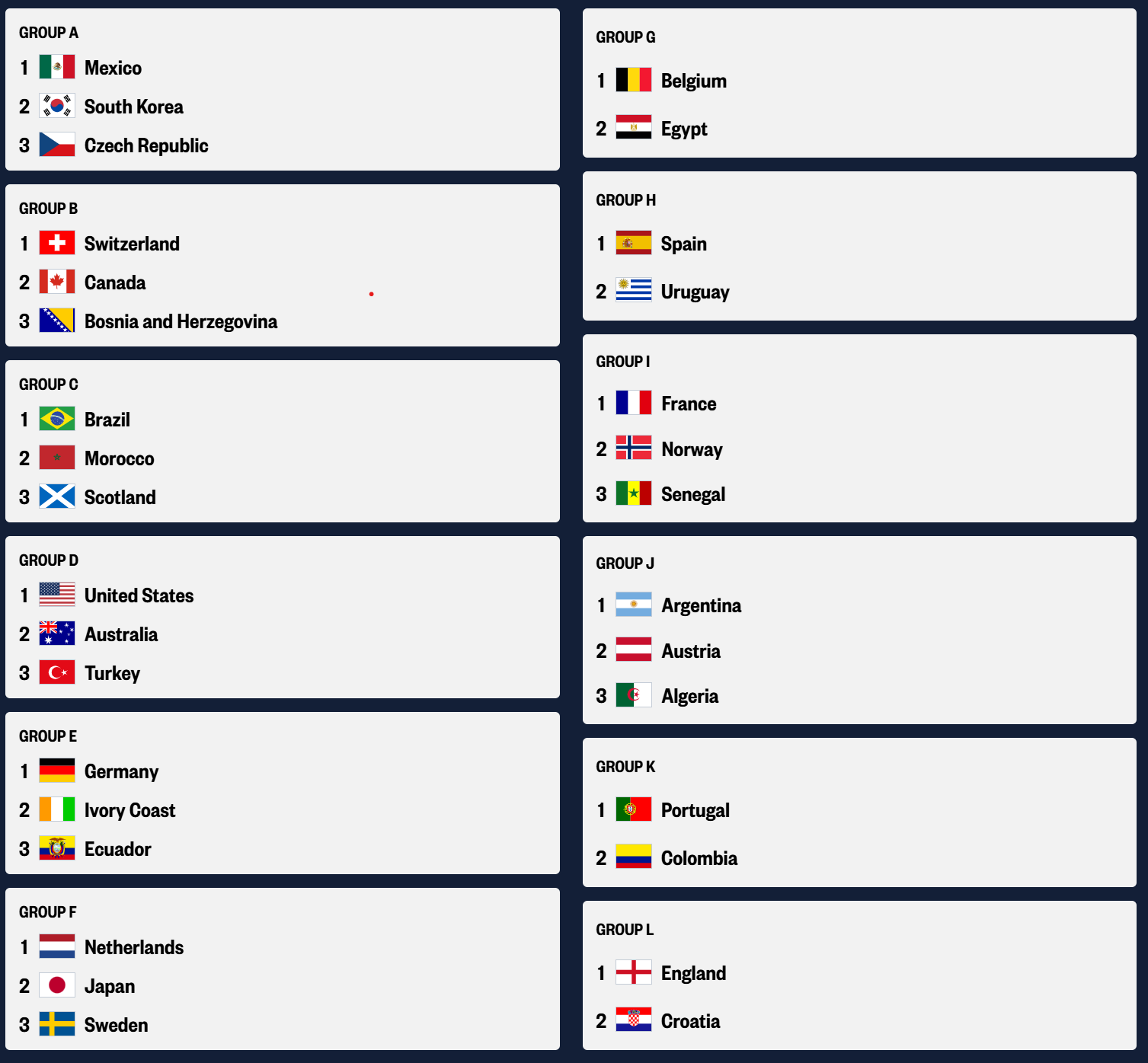
To wrap up, here are our forecasts for each group and how we expect the table to look after all three rounds of matches. We have also picked the eight best third-placed teams we think will go through to the knockouts, and once the group stage is over we will come back to these predictions and try to make up for any misses with our knockout-round calls. Of course, this is not financial advice 😀
InterCapital’s World Cup 2026 group stage predictions
Source: InterCapital estimate