
IBIT, BlackRock’s iShares Bitcoin Trust, is the largest Bitcoin spot ETF with over $50B in AUM. Launched in January 2024, it marked a pivotal moment for the institutionalization of crypto markets. Continuous investor inflows bid Bitcoin higher throughout 2024 and into 2025, compressing volatility across all tenors and transforming the retail-like call skew into an institutional-like put skew — a familiar hallmark of equity indices. Then the flash crash of October 10th, 2025, changed the tides. Bitcoin has now been in an unexpected bear market for the 6th straight month, despite solid and improving on-chain fundamentals. The popular explanation is that institutional investors are cashing out via spot ETFs. But is that truly the case, according to the available data?
Since October 10th, 2025, the Bitcoin price has fallen nearly 46%. On the other hand, IBIT shares outstanding contracted merely 4%; in other words, outflows from Bitcoin ETFs amounted to $8.5bn while AUM fell $48bn. This indicates that, despite serious price pressure, Authorized Participants (APs) are not redeeming their ETF shares into physical Bitcoin. APs are the firms that have a formal contractual agreement with BlackRock and the trustee to create and redeem IBIT baskets (blocks of 40,000 shares). Fund % premium or discount determines the APs’ incentive to redeem ETF shares for Bitcoin (if trading at a discount) or issue new shares by depositing Bitcoin for shares (if trading at a premium) to earn an arbitrage profit. While a quick interpretation could mislead towards a bullish leaning signal, it is important to mention[1] that 55-75% of the total IBIT shares are owned by market makers and arbitrage hedge funds, who operate hedged and non-directionally, mainly through market neutral strategies such as market making and levered basis arbitrage. In practice, though, names like Jane Street, Citadel Securities, Virtu Financial, and Jump Trading operate as both APs and dominant market makers across the ETF ecosystem. In fact, 11 of the top 20 largest IBIT position holders are firms actively involved in options trading, underscoring the extent to which ETF exposure is intertwined with derivatives positioning rather than purely long-term directional investment.
This explains both: a) why falling prices are not yet important for the largest IBIT holders since they are mostly hedged, and b) why the premium or discount stays only slightly negative during violent and prolonged price pressures. Nevertheless, market makers reduced around $2bn in exposure during Q4 25, it is mostly due to reduced arbitrage inventory requirements and a decline in speculative demand. Extremely bearish sentiment in historical terms, persistent negative funding rates across perps, along with high and increasing put OI and put skew point to heavy short positioning in the derivatives layer, explaining further how spot ETF structure has remained intact while price falls. Amongst IBIT holders other than APs and hedge funds, there are also institutional investors with longer investment horizons and low turnover, wealth managers and sovereign entities, but still, most of the ownership remains with retail investors.
To sum up, APs are absorbing and hedging via the derivatives layer regardless of the price being smashed on exchanges. In other words, investors are not leaving the ETF structure; they are leaving the price. And the price itself is being driven lower not by spot selling, but by derivatives positioning. This thesis could be invalidated if the ETF discount starts widening or if large share redemptions occur, or if BTC starts leaving custody in size. Since we are not witnessing any of the above, we could reasonably presume this was primarily a derivative-driven selloff rather than ETF-driven spot selling. This imbalance between structural holders and leveraged traders is creating the kind of structure that behaves like a “compressed spring”, where short squeezes tend to emerge once downside momentum fades and marginal sellers disappear.
[1] According to the 13-F filings Q425. 10x Research, The Institutional Reset: What Bitcoin’s Hidden Positioning Shift Reveals, 18Feb 2026.
IBIT US ETF performance (%)
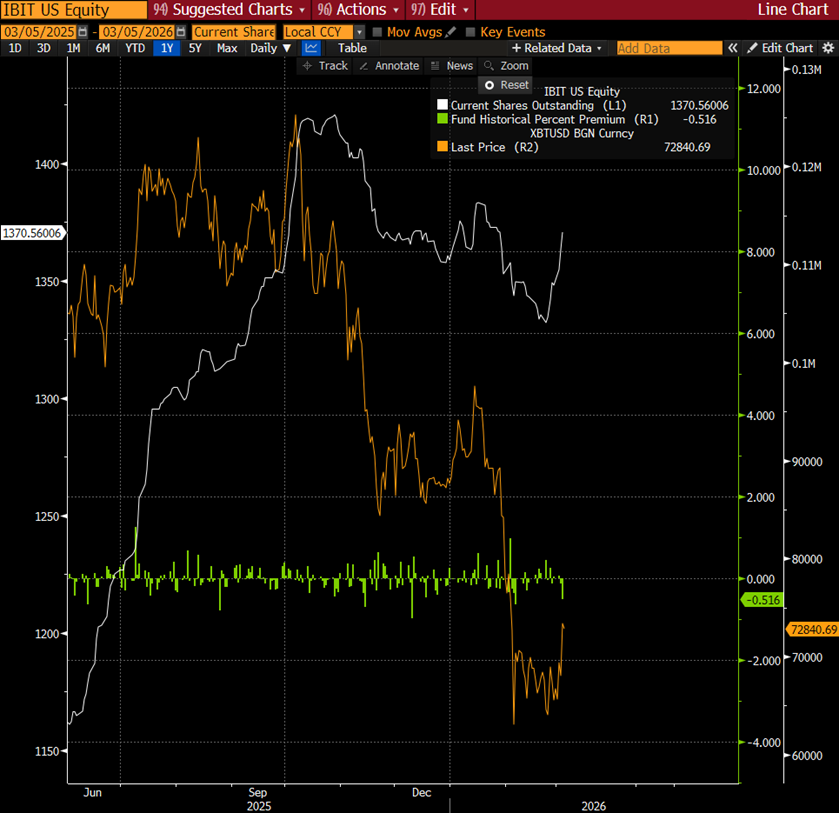
Source: Bloomberg, InterCapital