
You thought stocks are volatile and interesting while bonds are slow and boring? Well, think again – the bond market just got very fast and very unpredictable. The buy side doesn’t really like it, though. What are the key drivers and how do we weather the current fixed income storm – find out in this brief research piece.
Financial markets will be holding their breath ahead of October 8th report by Japanese Ministry of Finance about aggregate foreign bond holdings. The latest two reports (September 19th and September 26th) both indicated a net reduction in foreign bond holdings, but that was before Sumitomo Mitsui’s Head of Fixed Income Shinji Kunibe reported that his company dumped all the French debt (the aggregate value was not disclosed) and switched into short term German and Japanese paper. The report is often cited as the driver of French spread to Bund (“le spread“, not to be confused with “lo spread“, but no harm done if you do confuse them in the end) widening to the proximity of 160.0bps (reminiscent of the 2011-12 EU debt crisis), although a reversal occurred to the current 138.5bps. The other possible drivers occurring on the same day are clustered around French 2027 budget that is expected to deliver some 54bn EUR of budget savings (43bn EUR in new measures, 60% of which are scheduled to come from lower spending). The savings plan was received with a bit of skepticism, although it’s quite likely that the current government would use Article 49.3 to push it through parliament without a formal vote.
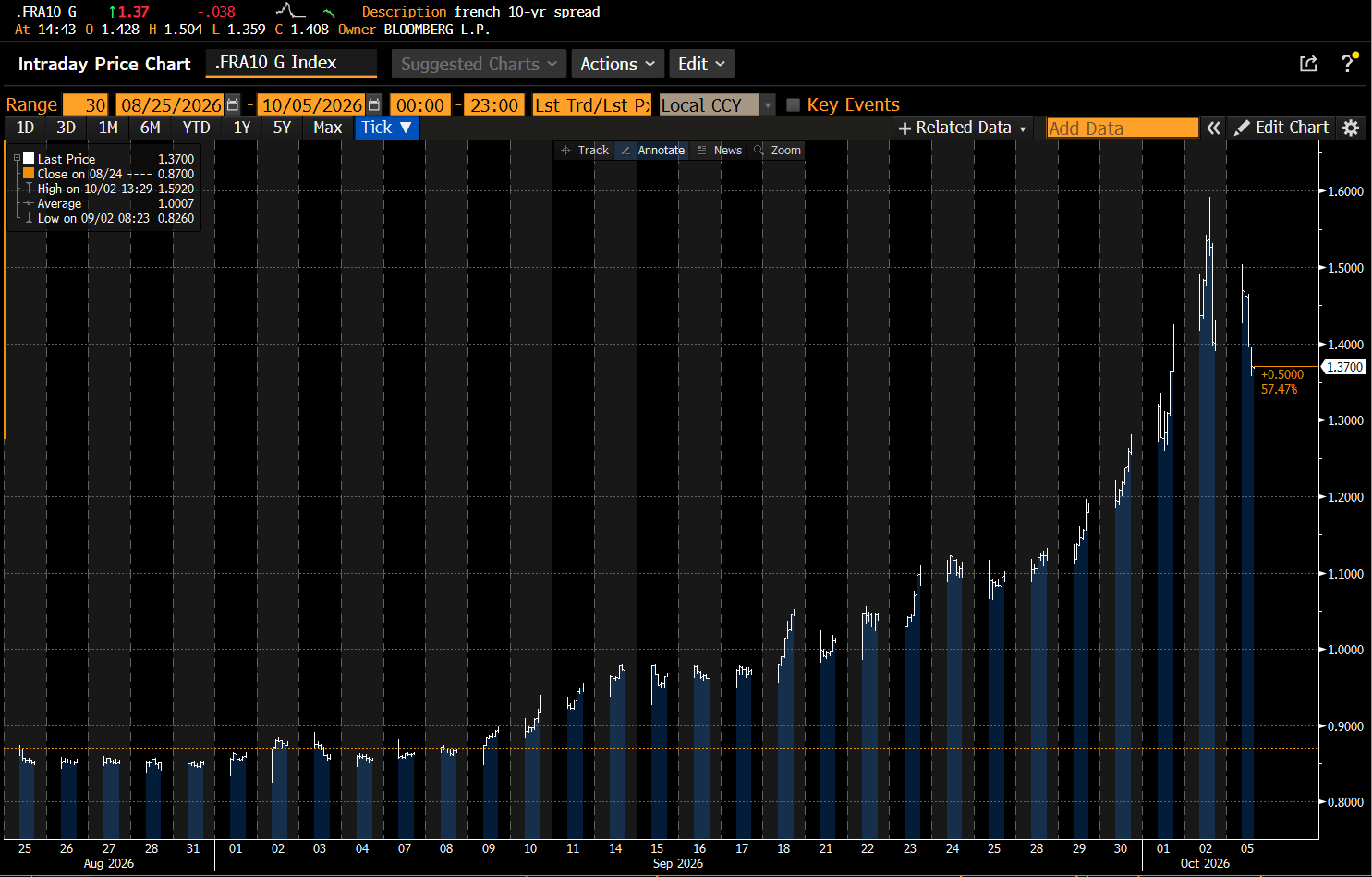
So why are the markets so skeptical? First of all, growth figures might appear a bit optimistic, but most of the investors discount comes from the fact that 40% of these measures come from higher public revenues. Then there’s the notorious macro backdrop – the 119% GDP in public debt with almost non-existent real GDP growth (USA at least has the AI renaissance to turn to) and rising debt servicing costs. French public debt WAM is around 9.3 years (compared to German 8.6 years, for instance) and the finance minister pointed out that roughly 85% of this year’s financing needs have already been covered.
What are the next key dates to watch? Looking at France alone, Moody’s is scheduled to review credit rating on October 23rd (Aa3, equivalent to AA-, with a negative outlook since October 2025) and it’s quite likely the rating will be coming down by a notch (S&P and Fitch hold it at A+ already). November 27th will be the date we really watch because S&P will be reviewing French credit rating – currently set at A+ with a stable outlook. Between the two rating events we have central bank meetings (FOMC at October 28th and ECB GC at October 29th), however the meetings are quite unlikely to deliver another rate hike. Without any November CB meetings, further rate hikes would be reserved for December. In mid December Article 49.3 can be used on French budget, so by then we would be familiar with budget deficit for 2027.
Since early March EGB yields exhibited a relatively high correlation to Brent crude, but then on Thursday October the 01st this correlation flipped to negative as French spread widening caused Bund yields to plummet. What we are closely looking at is whether this is an one time event, or the new normal. For the time being, it seems the positive correlation between German yields and Brent crude continues, absent of any new major French asset dump by major Asian holders.
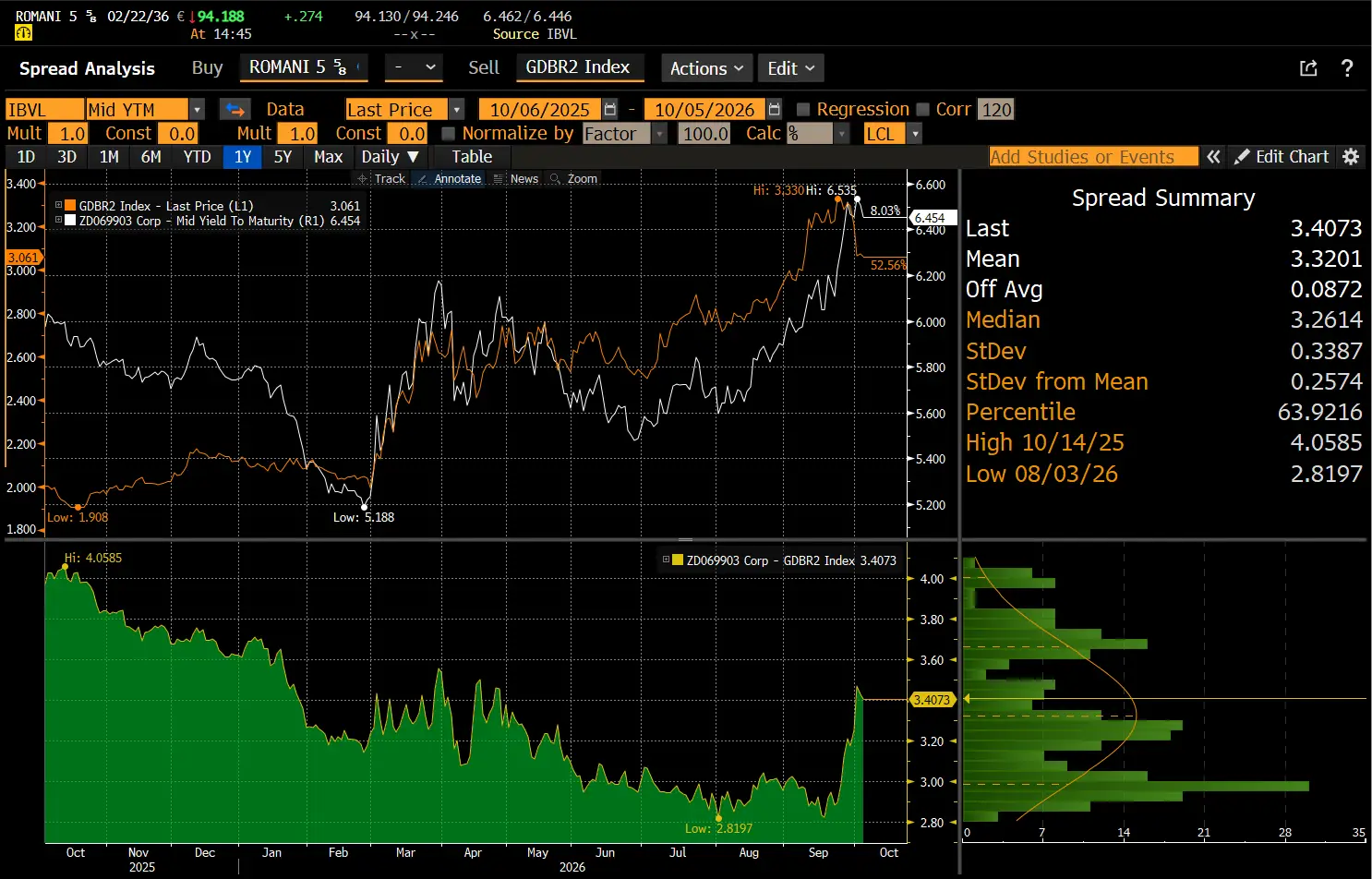
What’s going on with CEE/SEE region? Naturally, ROMANI 5.625 02/22/2036€ widened all the way up to Bund+340bps, a level reminiscent of March 2026 and early days of the war (back then we all thought this is going to last for a couple of weeks). Looking further in history we can clearly see the paper traded at much wider spreads to Germany. As French fiscal crisis spills over into European HY, countries such as Romania (without a stable government) and Serbia (with pending parliamentary elections) appear particularly vulnerable. The star student in all of this is Hungary – take REPHUN 1.75 06/05/2035€ for instance. The spread to Germany widened to about Bund+162bps but remains well off the March highs around Bund+200bps. Stable government and the prospects of entering euro area by 2030 manages to keep the spread widening at bay, while AKK’s announcement that no new international paper would be placed by the end of the year also gave buyers reasons to lift the offers. Croatian 10Y paper (CROATI 3.25 02/25/2036€) is traded at Bund+75bps, levels not seen for some time, however for buyers to emerge we would still need to see it a thad closer to Bund+100bps.
What could cause bond yields to reverse lower and for spreads to start to tighten from the current levels? Absent fiscal consolidation, we would look for signs that ECB is looking to put an end to it’s QT. This is exactly what BoE did a couple of weeks ago and caused long yields to push lower. There is a catch, however (there always is) – BoE was conducting active QT, i.e. they were actually selling long dated bonds. ECB’s QT on the other hand is on autopilot and the central bank merely rolls over less paper. An end of QT might cause spreads to tighten a bit, however this would be no cure to the original disease. Well, at least it won’t hurt.