
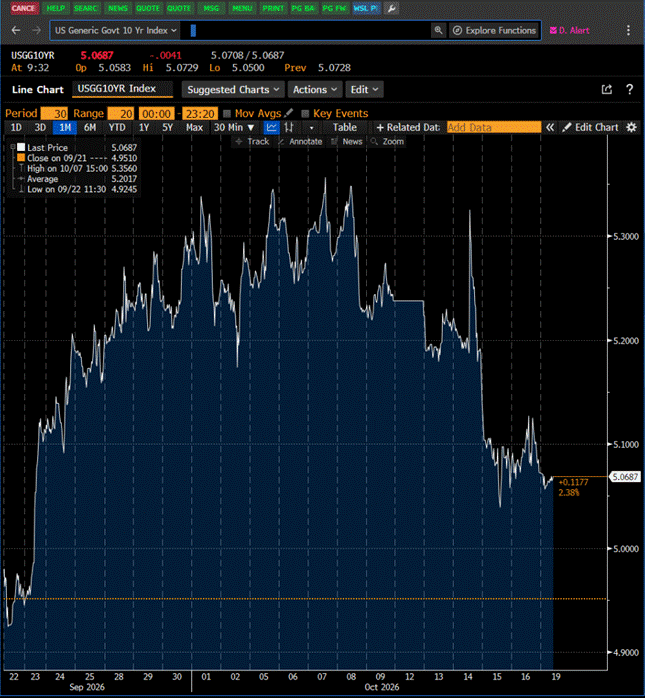
The US 10-year has had a loud month. An auction that needed the highest yield since 2000, a hot inflation print and a sharp selloff in tech stocks all came within a few weeks, and the yield covered a range of more than 40bps. Yet it sits only about 12bps above where it was a month ago. Zoom out to the one-month chart and it almost looks quiet.
US 10-year Government bond yield
Source: Bloomberg, InterCapital
Earlier this month, The Macro Compass described the bond market as searching for new clearing levels, the yields at which buyers finally step in with enough size to slow the selloff. Their view is that with inflation above target and deficits still supporting demand, yields keep rising until tighter financial conditions hit equities and do the job policymakers will not. They also make a point worth keeping in mind: reaching an equilibrium level does not mean bonds have to rally.
On the 10-year, 5% has played the role of that line. It held as a ceiling for most of September, broke on September 23rd, and the yield spent early October above it, peaking on the day of the 10-year auction.
The loudest stretch came in the week of October 12th, and it looked like that scenario in fast forward. September CPI came in above expectations, with services prices still firm, and yields pushed back toward the highs. Within hours, a sharp drop in AI and chip stocks sent money into Treasuries, and by the next morning the 10-year was almost 30bps below its post-CPI high. Equities did the tightening and bonds got the bid. The rally stopped short of 5%, and the week closed a little above it.
Options help put a number on this. The simplest volatility trade is a straddle: buying a call and a put with the same strike and expiry. Direction does not matter. If the future rallies, the call pays, and if it sells off, the put pays. The two premiums together are the cost and also the break-even, so the future has to move by more than that, either way, for the trade to make money at expiry.
Take the December options on the 10-year future (TYZ6), which expire on November 20th. With the future around 105-22, the 105.5 call costs a little under one point and the put about three quarters of a point. Together, the straddle costs about 1.66 points, which translates into roughly 27bps of yield. That is the average move the market expects over the next 32 days, a window that includes the FOMC on October 28th and the ECB a day later. It also ties back to implied vol: as a share of the futures price, an at-the-money straddle costs about 0.8 × implied vol × √time, and with implied vol around 6.6%, that is where the price lands.
Now apply the same logic to the past month. A buyer of a one-month straddle in late September paid for a move of similar size. A month later the yield is only about 12bps away, so without hedging, the trade lost money. A buyer who hedged along the way, buying the future on dips and selling it into rallies, had a much better month, because every swing inside that 40bps range was something to trade against. Where the yield ended up was not the story. How it got there was.
This is the uncomfortable part of owning straddles. Even at a fair price, and if moves are roughly normal, the buyer only wins in around 42% of cases, because the move has to be bigger than about 0.8 standard deviations. The good months pay for the bad ones, but more than half end like this one.
This brings us back to the clearing level. If 5% is where buyers now step in, the past month was the market finding it, and a flat one-month chart is what that looks like from a distance. But if equilibrium does not guarantee a rally, the next push higher can come from the same places as before: inflation that is not slowing, a Fed that offers little guidance, and a steady supply of new debt. Options are pricing about 27bps for the next month. Whether that comes as another round trip around 5% or a clean break away from it is what the next few weeks should tell us.