
Bitcoin price seems to have bottomed on the announcement that the widely anticipated legislative breakout “the Clarity Act” was convincingly repelled in the Senate with even numerous Republican senators voting against. The bill isn’t dead yet, a motion to reconsider has been filed. But a major industry setback, ironically, paved the way for some impactful rulemaking by the SEC that helped propel the next leg higher in crypto prices across the broader ecosystem. Despite the continued tension in the Middle East and the global bond selloff thriller, the asset class remained incredibly resilient, underpinned by continued BTC and ETH ETF inflows.
Initially, BTC fell more than 5% as the Clarity Act cloture vote failed (Sep15), with Coinbase and Circle shares (main beneficiaries of the law) dropping by over 10%. BTC price rebounded a day after announcement and kept gains; CRCL rose initially but retraced gains in the following weeks, while COIN remained slightly more buoyed, probably benefitting from steady increase in crypto trading volumes.
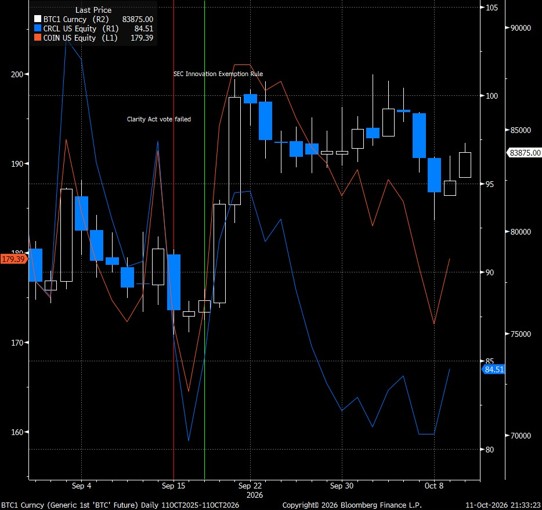
Source: Bloomberg, InterCapital
Namely, SEC created an “Innovation Exemption for tokenized stocks” (17Sep) that basically allows companies to facilitate on-chain trading of tokenized versions of listed US stocks, without formal registration as a traditional exchange and allowing some liquidity providers skip formal dealer registrations. This is sort of a win to DeFi (decentralized finance), since the SEC validates DeFi’s core mechanics (proof of concept) for real equities trading; trading settles without a central clearer, meaning trades settle directly against smart contracts (programs) on a public permissionless blockchain (Ethereum for example), with prices set by AMMs (automated market makers) which are basically algorithms that quote prices from the balance of assets in a pool. Liquidity providers deposit both sides of a pair (say, USDC and tokenized Apple) into that pool, earn fees for it and bear the pool’s risks. The catch is that these pools are permissioned, meaning that only approved participants can trade with the pool or supply liquidity to it because the smart contract checks whether your wallet is on an approved list (passing KYC for example). True DeFi doesn’t have gated access to pools, which is important to SEC to enforce AML and investor protection rules. In practice, this is DeFi technology (on-chain settlement, AMM pricing and no central clearer) inside a regulated wrapper, not open DeFi. Of course, an agency order is not a law in terms of robustness, since all rules are reversible, but it shows that regulators are pro-tokenization and pro-institutional access.
This is a 5-year, conditional exemptive relief in which the companies get 30-day notice and can block 3rd party tokenization of their stock; these tokens need to hold the same rights as ordinary underlying shares (dividends, voting); no leverage, no primary issuances, no synthetics and mandatory coordination with primary exchanges; the smart contract used to facilitate the trading needs to be auditable, public and on a permissionless blockchain. Also, SEC posted “Crypto asset FAQs” (Sept25) where they provide staff guidance that helps clarify when a token is or isn’t a security which is important for jurisdiction (SEC or CFTC). But the more important item for institutional flows is “Custody proposal” (Oct1) where SEC proposes letting advisers and registered funds self-custody crypto conditionally. Many tokens, newer blockchains and staking positions have no qualified custodian; the current rules bar RIAs (Registered Investment Advisors) and regulated funds from holding them. Letting advisers hold those assets themselves when no permitted custodian exists removes that automatic exclusion, so regulated money can reach parts of the market it was legally shut out of. However, this rule still faces a 60-day comment period ahead, so realistically, sometime in 2027 this could be enforced, facing the same durability problem that the future SEC could revise it.