
The US Treasury intervened in the bond market on August 19, announcing it would at least double its buyback operations for longer-dated Treasuries — from $2 billion to at least $4 billion per operation — targeting the 10- to 30-year sector from September 9 through November 4. A day later, Secretary Bessent told CNBC the operations could exceed $4 billion. The initial reaction was sharp: 30-year yields dropped 9 basis points, the 10-year fell to 4.647%, and stock futures rallied. Within 24 hours, the move had largely reversed — the 10-year was back at 4.71%, above pre-announcement levels. The pattern echoed his August 1 yen intervention alongside Japan: an initial shock followed by a gradual fade.
The context here is important to mention: 30-year yields had just hit 5.33%, the highest since 2007. A $25 billion long-bond auction the prior week cleared at 5.216%— the highest since 2001. US national debt crossed $40 trillion the same week, doubling in under a decade. The fiscal year 2026 deficit had already reached $1.8 trillion with two months remaining. CPI inflation printed 3.4% in July, with the energy component of the index up 14.7% y-o-y — driven by Iran’s restrictions on Strait of Hormuz shipping tightening global crude supply and distillate markets. The bond market was staging a buyers’ strike at the long end. The buybacks will probably be funded by issuing short-term T-bills — swapping long-term debt for short-term, not reducing nor increasing total borrowing. Evercore ISI noted Bessent was tactically squeezing bond shorts in thin August liquidity. The real story, however, seemingly wasn’t in Treasuries. It was in what rallied alongside the intervention.
The debasement trade returns
Gold surged to $4,557 by Friday — highest since June — rallying alongside falling yields rather than against them. Bitcoin jumped nearly 6% on announcement day, cleared $72,000 by Thursday, and pushed toward $77,400 by Friday, on track for a ~19% weekly gain. Both hard assets moving up simultaneously on a Treasury intervention is a signal the market is pricing something beyond rate differentials. This is the debasement trade. The concept is old — the term dates from ancient rulers reducing gold or silver content in coins to stretch the treasury — but its modern expression is straightforward: when governments run persistent deficits, expand the money supply, and intervene to suppress borrowing costs, each unit of currency loses purchasing power over time. Capital rotates out of fiat-denominated assets[1] into scarce ones, whose supply cannot be managed — gold, silver, and increasingly Bitcoin — as a hedge against that dilution. The Treasury buyback reinforced the thesis. The government isn’t reducing its debt — it’s rearranging its maturity profile to suppress yields while running deficits at 5.8% of GDP. The market reads this not as fiscal discipline but as the opposite: an admission that borrowing costs are unsustainable and the preferred response is intervention rather than consolidation.
Rebasement – debasement: the historical cycle
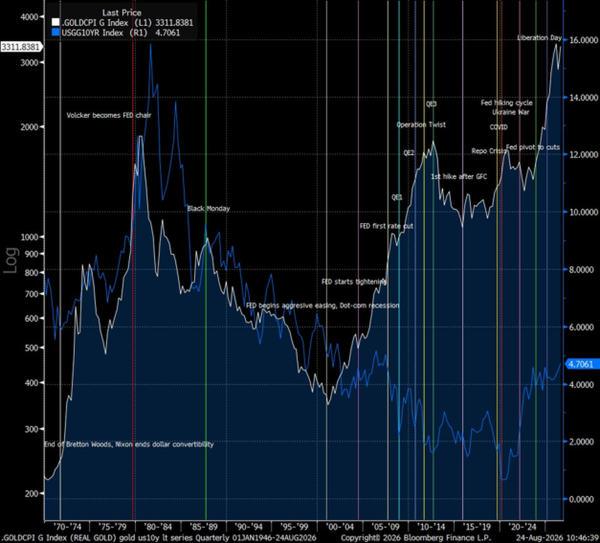
This isn’t new. The tension between debasement and rebasement has defined macro regimes for decades, and understanding which regime you’re in determines whether hard assets or fiat-denominated ones outperform. The 1960s and 1970s were the last great debasement period. The US abandoned the gold standard in 1971, ran widening fiscal deficits to fund Vietnam and the Great Society, and the Fed accommodated inflation rather than fighting it. Gold rose from $35 to $850. Real assets dominated. Equities went sideways in nominal terms and fell sharply in real terms. The bond market was a graveyard — by 1981, the 30-year yield had reached 15%. What followed was the Great Moderation — a roughly 25-year rebasement from the early 1980s through the mid-2000s. Volcker broke inflation with punishing rate hikes. Reagan and Clinton-era fiscal policy, whatever its flaws, moved toward balance — Clinton ran actual surpluses by the late 1990s. Globalization exported disinflation through cheap labor and goods. Central banks gained independence and credibility. The dollar strengthened. Long-term yields fell from 15% to under 5%. Capital rotated out of hard assets and into financial ones: equities, credit, duration. Gold collapsed from $850 to $250 by 1999. This was the rebasement trade in its purest form — investors trusted that fiscal and monetary authorities would protect purchasing power and were rewarded for holding fiat-denominated assets. The 2008 crisis planted the seeds of a reversal. Quantitative easing expanded central bank balance sheets from hundreds of billions to trillions. The Fed’s balance sheet grew from $900 billion in 2008 to $4.5 trillion by 2015. But the debasement trade didn’t fully ignite because deflationary forces — globalization, technology, demographics — absorbed the monetary expansion. Inflation stayed low, yields kept falling, and financial assets kept rising. Gold recovered to $1,900 but couldn’t sustain it. COVID changed the equation. The fiscal response injected trillions directly into the real economy rather than channeling it through bank reserves. Inflation arrived — not as a monetary abstraction but as a lived experience. The Fed’s balance sheet peaked at nearly $9 trillion. And critically, the deflationary forces that had offset prior monetary expansion began reversing; supply chains reshored, geopolitical fragmentation replaced globalization, and energy costs structurally reset higher. By 2025, the debasement trade was back. Goldman Sachs named it explicitly in their January 2026 gold note. Gold broke above $4,300. Central banks — particularly in emerging markets pursuing de-dollarization — accumulated gold at record pace. Bitcoin entered the same conversation, offering digital scarcity alongside physical scarcity, though with significantly higher volatility. Silver outperformed both in 2025, gaining 144% versus gold’s 65%.
Gold price adjustment for CPI (left scale, log) and US 10Y yield (right scale), 1970-2026
Source: Bloomberg, InterCapital
Where are we now
The August buyback wasn’t a one-off technical adjustment — it was the latest move in a regime where the government is actively managing its borrowing costs while running $1.8 trillion deficits with $40 trillion in total debt and $1 trillion in annual interest expense. The CBO projects gross federal debt reaching $64 trillion by 2036, or 120% of GDP — exceeding the post-WWII record. Rebasement counter-thesis still exists; governments restore fiscal credibility through deficit reduction and spending discipline, the dollar strengthens, and hard assets underperform. Parts of 2026 tested this — gold fell sharply from its highs, Bitcoin lagged equities, the dollar stabilized. But the August selloff and intervention swung the pendulum back. Gold and Bitcoin’s simultaneous rally on a Treasury intervention suggests the market is repricing the likelihood that fiscal consolidation arrives before the debasement thesis plays out. The paradox is structural. If the Treasury succeeds in suppressing yields, it validates the debasement thesis — intervention replaces market pricing, fiat credibility erodes further, and hard assets find a bid. If it fails, yields resume climbing, financial conditions tighten, and the economic damage forces even larger fiscal responses. Both paths lead to the same question: whether the forces driving the debasement trade — deficits, debt, monetary intervention — prove stronger than the institutional credibility required to reverse them. For now, the Treasury has bought time. How much depends on whether this is a tactical pause or the beginning of a structural intervention cycle that the market will eventually price as permanent.
The week ahead could amplify or defuse the tension. Wednesday brings both the July core PCE print — the Fed’s preferred inflation gauge, expected at 3.3% annual — and Nvidia earnings after the bell, the latest test of AI-spending durability in an environment where rising yields pressure long-duration growth stocks. Thursday opens the Jackson Hole symposium, with Fed Chair Kevin Warsh speaking Friday in his first appearance as chair — a two-way risk event given his deliberate avoidance of forward guidance. The BLS annual payroll benchmark revisions, also due Wednesday, could quietly reframe the labor market picture. Hot PCE alongside hawkish Warsh rhetoric would push yields higher and test the Treasury’s buyback credibility; a softer print with dovish undertones would give Bessent’s intervention room to breathe.
[1] Fiat – an authoritative command or act of will.
Fiat money – paper money not backed by a physical commodity. Its value comes from government decree and public trust (IOU – I owe you).