
If You thought Friday 13th is an unlucky date, You obviously didn’t check the latest Romanian flash GDP print at +2.1% QoQ (vs. BBG consensus at +0.5% QoQ). The surprise was likely caused by better EU fund (RRF) withdrawals and we still point out the weakness in automobile manufacturing as one of the obstacles the overall figure will have to overcome to breakeven (Romanian GDP decreased by -0.3% YoY in the first nine months of 2026). How did this play out on the bond market? Find out in this brief research piece.
Investors in Romanian assets were surprised twice in the last ten trading sessions. The first surprise came on Monday, November 02nd, when Romania announced that it’s placing a triple tranche of international EUR-denominated bonds (4Y/8Y/12Y). Although the announcement raised only a few eyebrows since solid international bond placement was in the cards in the coming months, statements from the Ministry of Finance were pointing out in the direction of local bonds instead of international bonds. Still, the October’s election of Luca Niculescu as the new PM set the Romanian spread on a firmer footing, so naturally the Ministry of Finance decided to put the good news to use and go with an international bond placement. IPTs were more than decent and were set at MS+210bps (for ROMANI 5.25 11/09/2030€) vs. FV MS+175bps (implying 35bps of NIP), MS+310bps (for ROMANI 6.125 11/09/2034€) vs. FV MS+275bps (implying 35bps of NIP) and MS+360bps (for ROMANI 6.750 11/09/2038€) vs. FV MS+320bps (implying 40bps of NIP).
Investors were aware that IPTs were merely the starting prices/spreads and a lot of tightening was expected, but still the spreads looked more than decent. The orderbook reached 8.5bn EUR and the Ministry of Finance decided to place 4.5bn EUR at MS+190bps (2.1bn EUR orderbook vs. 1.25bn EUR placement, implying a 1.68x bid-to-cover), MS+285bps (3.8bn EUR orderbook vs. 2.0bn EUR placement, implying a 1.90x bid-to-cover) and MS+335bps (2.6bn EUR orderbook vs. 1.25bn EUR placement, implying a 2.08x bid-to-cover), respectively. And yes, the paper with the widest NIP (that would be ROMANI 6.750 11/09/2038€) also reported the highest bid-to-cover.
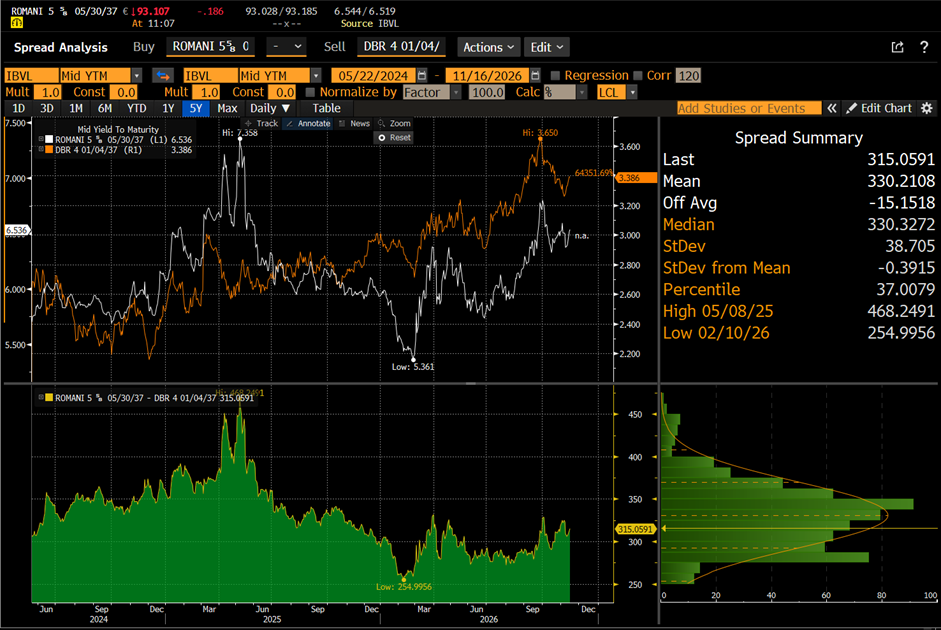
The story of the Romanian spreads to benchmark (Bunds or mid-swaps) is very well known to CEE investors. Last year, just before the presidential elections (May 18th, 2025), ROMANIA 5.625 05/30/2037€ was traded at DBR 04/01/2037€+470bps (two year longer maturity was in the vicinity of 500bps spread to Bund). After pro-European candidate Nicușor Dan managed to defeat George Simion with a considerable margin, the spread went on one of the fastest slides ever recorded and just before the Hormuz crisis broke out, the paper was traded as tight as DBR 04/01/2037€+255bps. Even without the Hormuz blockade analysts were pondering is this valuation just a bit too tight since country will definitely have to go through a tough period of fiscal contraction that might weigh on economic growth in years to come. With a spike in volatility following war in the Middle East, the spread at first widened to DBR 04/01/2037€+335bps, then the MOU tightened it to DBR 04/01/2037€+282bps, and with the resumption of war hostilities in late summer the paper is now traded at DBR 04/01/2037€+315bps.
In the opening line of the report I have mentioned that Romania surprised CEE investors for the second time lately – the odd one here is that the second surprise happened on Friday 13th and was quite a positive one. Romanian GDP print surprised to the upside in 3Q2026: flash GDP increased by +2.1% QoQ SA (BBG consensus was expecting +0.5% QoQ), which translates roughly into +8.7% annualized. The only way Romanian GDP could deliver such a high print was through much better RRF withdrawal (albeit a better agricultural season could have given a hand as well).
Now brace yourself for some cold water ahead. First of all, Romanian GDP still contracted by about -0.3% YoY in the first nine moths of the current year. If the ultimate quarter also delivers a strong, positive figure, maybe the overall GDP growth manages to get close to zero. In a year like 2026, zero might look like a new plus. But second, and possibly even bigger problem, are woes in Romanian automobile manufacturing. Romanian automobile manufacturing contributes to Romanian GDP by as much as 13.2% and ACAROM (Romanian association of car manufacturers) reported that in the period January-October total car production in Romania declined by as much as -13.2% (in October alone the drop was most pronounced at about -20% YoY). Without a plateau in car manufacturing, the best we can really hope for Romanian GDP growth this year is a positive zero – and even that with fingers crossed.
To end the research piece on a more positive note – all the three new Romanian international bonds fared well on the secondary market and are currently traded closer to FVs, meaning that the market extracted the NIPs and kept the paper in the portfolio, with only a handful of fast money accounts deciding to sell.